
Milwaukee City Directory Shelves
Milwaukee Public Library holds the county's main city directory spine. The run starts in 1847 and continues to the present, though some years were not issued and a few early volumes are missing. Researchers can browse every available year by name. Address browsing begins with 1921, which makes the later volumes useful for working from a house or storefront back to a listed occupant. The exact format changes by date. Early books may be at a reference desk, later volumes sit in the Zeidler Room, and long runs are available on microfiche or microfilm.
| Collection | Years | Where Held | Access |
|---|---|---|---|
| Milwaukee City Directory | 1847-present | MPL Zeidler Room | Name browse all years; address browse from 1921 |
| Murphy & Hogg run | 1847-1884 | Central Library Adult Art Rarities | Library use; request at desk |
| Microfiche and microfilm | 1847-1960 | Zeidler Room and Periodicals | Microfiche 1847-1860; microfilm 1861-1960 |
| Digitized directory pages | 1861-1960 | Ancestry Library Edition | Library database access |
| Telephone directories | 1931-present | Zeidler Room and Periodicals | Availability varies by year |
The Milwaukee Public Library local-history overview is the best first check for formats and desk locations. CountyCat identifies exact titles and call numbers, including the library-use-only Murphy & Hogg volumes. A blank year should not be treated as proof that a household left Milwaukee County. Publication gaps, missing books, spelling changes, and different inclusion rules can all create silence.
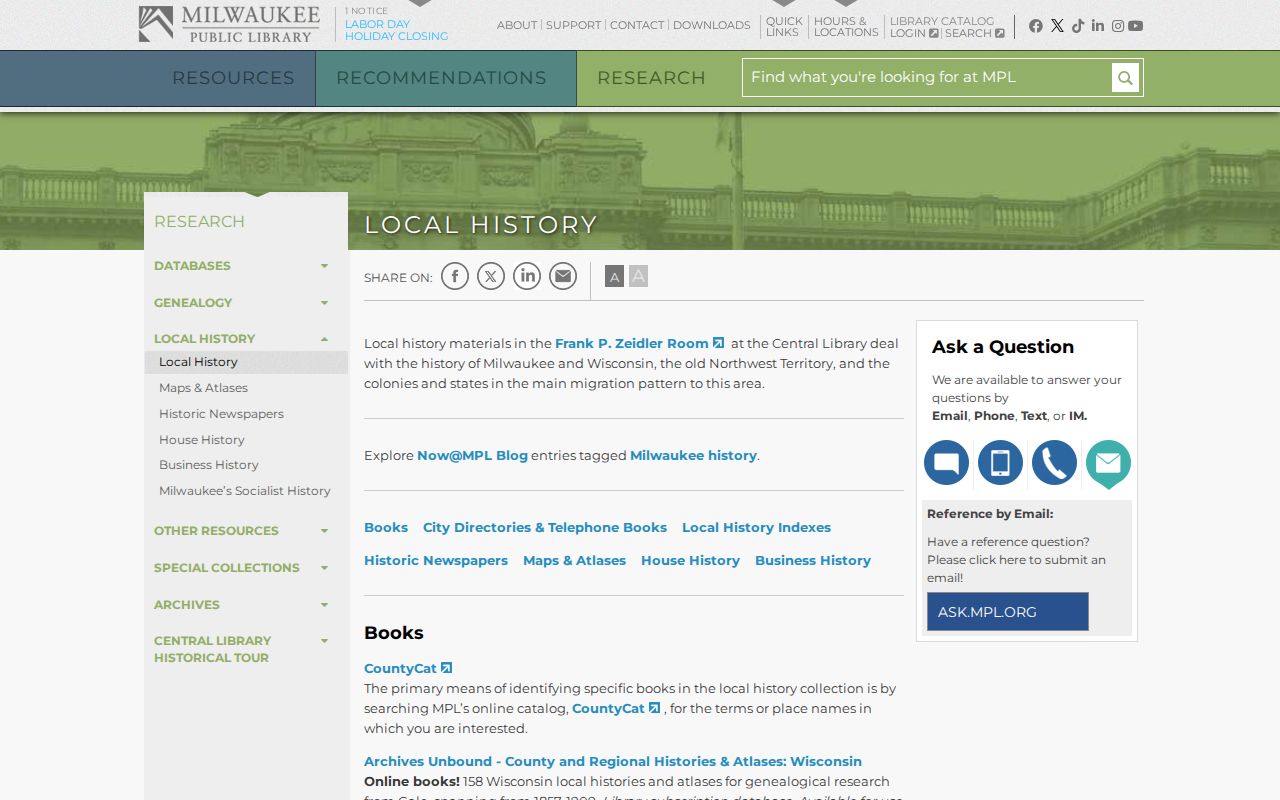
The library collection view confirms that directory access is divided among print, microform, and desk-supported sources rather than one complete public download.
Milwaukee Directories by Format
A format choice can save time. Print is easiest for flipping between the name and street sections. Microfilm gives a continuous 1861-1960 run at the Periodicals Service Desk, while microfiche covers 1847-1860. Ancestry Library Edition digitizes the 1861-1960 run listed by MPL, but page images and search results should still be checked against the original page. Optical character recognition often misses initials, old type, hyphens, and immigrant surnames.
CountyCat is a locator, not always a download. A catalog status such as “library use only” means the volume must be requested and read inside Central Library. If the needed year does not appear online, call the Zeidler Room or Periodicals desk and ask which physical format holds it. That fallback keeps a failed web search from becoming a false conclusion.
The MPL local-history page also points researchers toward historic newspapers, maps, census tools, and WISDEX once a directory supplies a name or date.
Early Milwaukee Directory Publishers
Milwaukee's earliest cataloged directory line begins in 1847. Murphy & Hogg volumes cover a run through 1884, with catalog examples for 1847/48, 1848/49, 1851/52, 1856/57, and 1857/58. Titles and publishers changed. The 1856 Milwaukee City Directory and Business Advertiser was issued by J. M. Van Slyck, while the 1863 volume was published by Starr & Son and compiled by A. Bailey.
The early books contain more than alphabetical names. Government and business matter, additions, removals, street references, and occupation lists can explain an entry that appears incomplete in a search result. The digitized 1863 Milwaukee directory shows the title, index, page structure, and the compact language used for residents and trades.
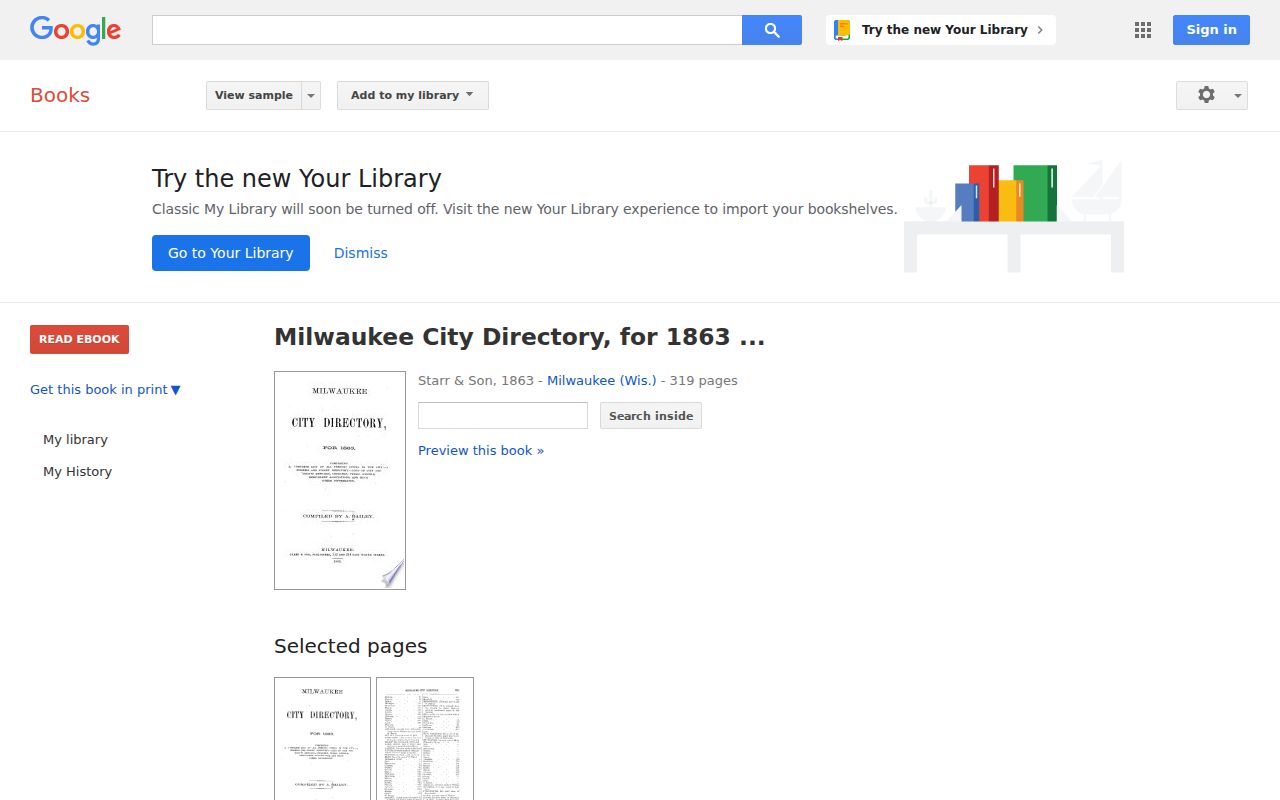
The scan is useful for testing names and abbreviations before requesting the corresponding print or microfilm edition at the library.
Milwaukee City Directory Address Browsing
Name browsing is available across MPL's run, but address browsing starts in 1921. In later city directories, the street or reverse section lets a researcher begin with a number and find the listed householder. That section is often called criss-cross because it reverses the usual name-to-address order. It works well for a house, shop, or block, yet it may list only a principal adult and should never be read as a full roster.
For current parcel work, use the Milwaukee County street directory. Historical directory entries serve a different purpose: they show how a name, occupation, and address were printed in one edition. Check the volume's front matter before comparing two years, because punctuation and inclusion rules may shift.
Read Milwaukee City Directory Entries
A short Milwaukee city directory line can hold several facts, but only if its key is read first. In the 1856 and 1863 scans, h means house, bds means boards, bt means between, and cor means corner. Occupations are shortened too: carp for carpenter, shoemkr for shoemaker, and lab'r for laborer. A business location is not necessarily a home address, and a named householder does not establish every person who lived there.
| Name | Surname, given name, or initial; some editions add a spouse or qualifier |
|---|---|
| Work | Occupation, employer, trade, or separate business location |
| Residence | Street number, street, ward, side, corner, rear, or boarding notation |
| Household clue | Spouse, widow notation, or a principal adult, depending on the edition |
| Later details | Apartment and telephone information may appear in later runs |
- Criss-cross directory
- A directory arranged by street and house number instead of by surname.
- Householder index
- An address-based list of the principal person recorded for a dwelling, not every occupant.
- Abbreviation key
- The edition's own list of shortened words and marks, usually in its opening pages.
Copy the entry exactly, including initials and marks. Then write a plain-language transcription beside it. Keeping both versions helps another researcher check the page without losing the original evidence.
Milwaukee's 1930 Directory Converter
Almost every City of Milwaukee house number changed in 1930, and many south-side streets changed names. Wauwatosa followed with street-name changes in 1931. Cambridge Avenue was renumbered more than once. This is why the converter belongs beside any city directory search that crosses those years. A resident who seems to disappear may still be at the same building under a new number.
The City Historic Preservation Commission research guide explains the address bridge and points to permits, deeds, census material, maps, and directories. Preserve both old and new addresses in research notes. Street intersections, lot and block descriptions, and fire-insurance maps can confirm that both numbers refer to the same site.
Insider tip. Search the last pre-conversion volume and first post-conversion volume side by side before concluding that a family moved.
Milwaukee Directory Archive Fallbacks
When the city directory shelf stops short, the Harry Anderson Research Library at the Milwaukee County Historical Society adds county records and family collections. Its holdings include naturalization files, early court material, coroner's inquests, marriage applications, jail registers, probate records, manuscripts, military rosters, and portraits. The materials are for reference use and cannot be checked out.
Beginning May 18, 2026, the MCHS research library offers appointment blocks on Monday, Friday, and Saturday while collections move to off-site storage. Booking at least a week ahead is recommended. Two-hour sessions are listed at 10 a.m., 1 p.m., and 3 p.m. Remote simple research costs $15 and complex research costs $25; scans are $0.50 per page and physical copies are $1 per page, with a $10.50 mailing charge.
Ask for a collection number and box or folder scope before traveling. The University of Wisconsin-Milwaukee Archives and Wisconsin Historical Society catalogs cover different material, so a negative result at one repository does not settle the question.
Milwaukee Residents in News Indexes
A city directory supplies a dated name and address. Milwaukee Public Library's newspaper indexes can then add a death notice, organization, family member, or next location. Coverage includes the Milwaukee Sentinel from 1844 through 1968, the Milwaukee Journal from 1935 through 1980, and the Journal Sentinel from 1990 to the present. Image and text access varies by title and license.
WISDEX is a Wisconsin biographical name index, not a certificate. Treat it as a pointer to the cited source. Milwaukee's German, Polish, Jewish, Irish, and African American collections can also explain spelling shifts and translated given names. Search initials, phonetic spellings, maiden names, and the directory's own abbreviation key before ruling out a match.
Trace Milwaukee Families by Directory
A Milwaukee County family trail is strongest when city directories bridge the ten-year census gaps. Federal census household images are public through 1950 under the 72-year rule. A census may show relationships and birthplaces that a directory omits, while annual or near-annual volumes can narrow a move, death, or change in work.
- Normalize the street with the 1930 Milwaukee converter or the 1931 Wauwatosa changes.
- Find the person by name, then read the same address in the street section where available.
- Repeat in five- or ten-year steps and mark years that were not published.
- Compare 1900 through 1950 census years with the nearest directory editions.
- Use newspapers, probate, cemetery records, and deeds to test deaths, heirs, and moves.
Disappearance alone proves little. A person may have moved, died, changed a surname, been omitted, or fallen into a publication gap. Record the last appearance, first absence, and next confirmed event. This keeps a likely story separate from a documented one.
Sanborn fire-insurance maps can test whether a building existed and how it was used, but they do not name residents. The 1894 Milwaukee volume at the Library of Congress has 106 sheets. MPL holds atlases from the 1870s through the 1960s, providing a useful physical setting for directory evidence.