
Milwaukee Previous Resident Sources
Milwaukee County previous residents leave different traces in each era. Start with the source most likely to cover the date, then join its address or name to the next record. County deeds reach deep into the nineteenth century, but older search methods differ. Milwaukee city directories begin in 1847, with address browsing available from 1921. Permits, census schedules, Sanborn maps, probate files, and newspapers each answer a narrower question.
| Source | Years It Covers | Where Held | What It Shows |
|---|---|---|---|
| Register of Deeds recordings | 1835-present | Tapestry, Room 103, archive | Transfers, liens, plats, and legal descriptions |
| Digital Reel | 1920s-1989 | Register of Deeds | City assessor grantor/grantee index by taxkey |
| Milwaukee city directories | 1847-present | MPL, MCHS, library database | Names, addresses, and occupation clues |
| Federal census | Public through 1950 | NARA, MPL, MCHS | Household members, relationships, and birthplace |
| City building permits | 1888 evidence; microfilm from 1900 | Development Center | Construction, alteration, use, and permit dates |
| Sanborn maps | Milwaukee volumes 1894-1951 | Library of Congress, MPL, UWM | Building footprint, material, use, and numbering |
For a recent address, copy the taxkey from the assessor or map first. For a twentieth-century household, try the address section of a directory near a census year. Before 1921, search directory names and use deeds, maps, and census geography to anchor the place. The City's house-history research guide connects these paths and warns that a deed records transfer, not the construction history or actual occupants.
Milwaukee Previous Residents by Taxkey
A modern street address can change, but the parcel record supplies stronger keys. Search the City Assessor or Map Milwaukee for a City parcel. Copy the taxkey exactly, including separators or leading zeroes, plus the situs address, owner display, mailing address, and legal description. Situs means the physical property address. The owner's mailing address may be somewhere else and is not proof of residence.
Suburban parcels require the county Land Information Office and the correct municipal assessor. Milwaukee County has separate local custodians outside the City, so a mailing city or ZIP does not identify the right counter by itself. If a parcel was split, merged, or placed in a condominium, record every related taxkey before going backward.
Trace Milwaukee County's Deed Chain
The Milwaukee County Register of Deeds indexes the recorded interests tied to a parcel. A chain of title is the ordered line of transfers affecting that property. Begin with the current purchase deed, then use its seller as the next person to search. Keep deeds apart from mortgages, releases, quitclaims, transfer-on-death instruments, and probate deeds. Each instrument can name people, yet not every one is a sale or proof of occupancy.
- Pull the current taxkey, legal description, situs address, and owner from the official parcel source.
- Find that owner's purchase instrument in Tapestry and record its document number, date, grantor, and grantee.
- Search the seller as a prior grantee to locate the deed by which that person acquired the parcel.
- Repeat backward, matching the legal description each time instead of trusting the street number alone.
- For early records, use book/page, document number, Digital Reel, or an archive appointment.
- Grantor and grantee
- The grantor gives or transfers an interest; the grantee receives it.
- Chain of title
- The linked sequence of recorded transfers for the same parcel.
- Legal description
- The lot, block, subdivision, or metes-and-bounds wording that identifies land despite address changes.
Extract the role, instrument type, and prior reference as written. A person can be a seller in one document, a borrower in another, and an heir in a third. Those roles should remain distinct. If the legal description changes, investigate a split, assembly, annexation, or neighboring parcel before continuing.
Milwaukee Previous Resident Search Break
The online history is broader than a simple 1962 cutoff. All recordings from 1962 forward are digitized, and deeds reach back to 1835. Deeds from April 1, 1948 forward can be found by grantor, grantee, tract, or document number. Earlier digitized deeds require a document number or book and page. A failed modern name search therefore does not mean the old deed is missing.
The Register of Deeds real-estate records page explains the date split and copy routes. Tapestry charges $6.95 per search session, $1.50 for the first printed page, and $1 for each added page. Certified copies come from the county, not Tapestry. At the counter, listed copy charges are $2 for the first page, $1 for each added page, a $10 search when no document number is supplied, and $1 certification.
The Tapestry search screen shows the online entry point for grantor, grantee, tract, and document searches.
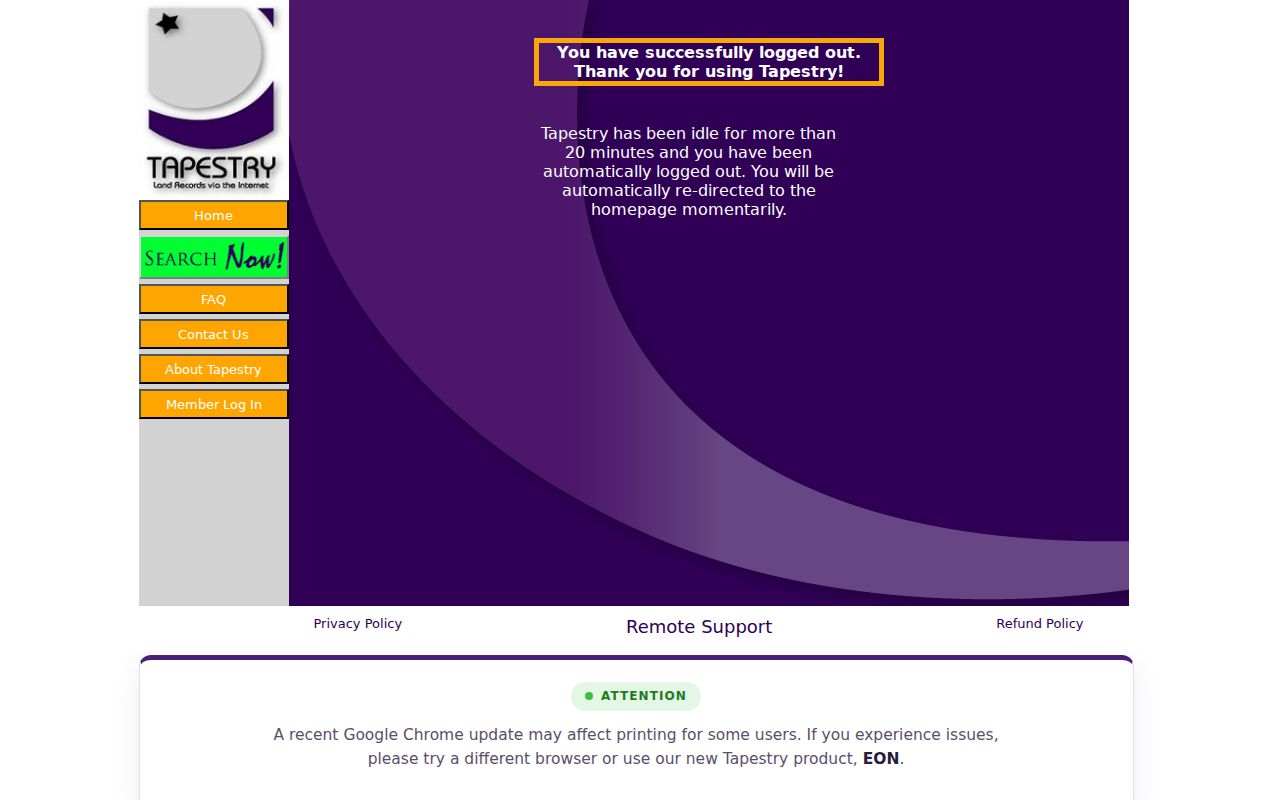
Carry each result's document number and book-page reference into the next backward step, especially near the older search boundary.
Insider tip. Pre-April-1948 deeds may be digitized even when a grantor or tract query cannot reach them; carry book-page references backward.
Milwaukee Previous Resident Deed Access
Historical searches can continue at the Register of Deeds, 901 N. 9th Street, Room 103. Complex archive work requires an appointment at least 24 hours ahead. Staff guide researchers but do not build the chain for them. Phone help is available at (414) 278-4001 for document research and copies or (414) 278-4021 for general questions.
A mail request should include the document type and number if known, whether certification is needed, a full name, property address, telephone number, and a check payable to Milwaukee County Register of Deeds. The office says received copies are mailed first class the next business day, and a typical deed totals $14. A narrow Wisconsin Chapter 19 request is another route when a specific parcel card or record cannot be obtained through a portal.
Milwaukee Past Residents Before 1930
Milwaukee's near-universal 1930 number conversion can make previous residents appear to vanish. Many south-side street names changed too, and Wauwatosa changed street names in 1931. Cambridge Avenue was renumbered several times. Always preserve the historic address and its normalized modern form as separate fields.
Use the municipal converter, street intersections, a legal lot and block, and a Sanborn sheet to test continuity. Fire-insurance maps may show old and new numbers. The Library of Congress holds a public-domain 1894 Milwaukee Sanborn volume with 106 sheets, while MPL holds atlas coverage from the 1870s through the 1960s. The maps date footprints, materials, stories, and uses, but do not name past residents.
The official Milwaukee house-history guide places the converter within the broader deed, permit, directory, census, and map workflow.

Its source sequence helps keep a changed street number from breaking an otherwise sound resident trail.
Milwaukee Resident Records in Permits
City building permits can add construction, alteration, occupancy, and major-work dates to an address history. The online historical instructions begin in 1997, while Development Center microfilm reaches back to 1900 and the municipal guide cites City-limits construction material from 1888. That older film is a key fallback when the current portal returns nothing.
Visit the Development Center at 809 N. Broadway for early permit material, call DCD at (414) 286-8211 for building-permit help, or call DNS at (414) 286-2268 for code-enforcement questions. A permit applicant or contractor is a dated record contact, not automatic evidence of residence. Use the permit to date the structure, then use directories and census records for the household.
Milwaukee Previous Resident Archives
The Zeidler Room, Milwaukee County Historical Society, UWM Archives, Library of Congress, and NARA provide the archival path when address portals stop. MCHS can connect a house trail to probate, court, naturalization, family, or organization collections. Its May 2026 schedule offers two-hour appointments on Monday, Friday, and Saturday while collections are moved off-site.
The Harry Anderson Research Library also accepts remote requests. Simple research is listed at $15 and complex research at $25, with scans at $0.50 per page and physical copies at $1 per page. Give staff every address form, surname variant, date range, taxkey, and record type. Specific details lead to a better collection search.
Milwaukee Past Household Evidence
Owners are only one layer. Milwaukee city directories can supply a listed occupant, spouse, work, or boarding mark, and address browsing begins with 1921. Federal census schedules can show fuller households and relationships. Pair the nearest directory editions with the public census years through 1950. The collection formats and entry marks are covered on the Milwaukee County city directory page.
- Check the address in a directory near a census year and copy every mark exactly.
- Search each named person in the alphabetical section for a spouse, work site, or later address.
- Compare the census household, allowing for spelling variants and changed street numbers.
- Repeat before and after the target year to narrow first and last appearances.
- Close the trail with an obituary, probate file, cemetery result, or next-address entry.
MPL obituary index coverage includes the Milwaukee Sentinel from 1844-1968, Milwaukee Journal from 1935-1980, and Journal Sentinel from 1990 to the present. Probate reaches the 1830s and may name heirs, inventories, land, or buildings. Pre-1985 probate files are office-only; later access varies between Room 207 and WCCA. A deed date is not a move date, so label each conclusion by its source.
Lawful use. Research Milwaukee County previous residents for family history, property history, or personal curiosity. Never use an address trail to harass, stalk, or harm a living person.
Build a dated table with the address as written, normalized address, taxkey, legal description, instrument type, grantor, grantee, directory year, entry, permit date, and confidence note. When sources conflict, preserve the conflict. Two independent keys, such as a legal description and taxkey or a converted address and directory entry, are far stronger than a same-name match.