
Finding Milwaukee Residents Carefully
Start with the fact you actually hold. A current address fits the City Assessor or a municipal assessor, while a name fits the recorded-document index, court indexes, probate files, or an old directory. A phone number is just a clue. No phone lead replaces an official source. Every source has limits. An assessor names the party assessed for a parcel, a deed names parties to an instrument, and a directory records only what its publisher gathered.
Ownership and residence are different facts. A mailing address can point to an owner who lives elsewhere. Many occupants never show on a parcel card. MyVote serves electors checking their own records. It was never built for browsing households, and older directory volumes skip years and names besides. Strong resident lookup work joins two independent keys, such as an address and taxkey or a directory entry matched to a deed date.
- Search the correct assessor by address and copy the taxkey, situs address, owner display, and record date.
- Use MyVote Wisconsin only for the permitted elector lookup, with full name and birth date or a complete address.
- Follow a land lead through the Register of Deeds by party, tract, document number, or book and page.
- For an earlier household, check the Milwaukee Public Library directory year closest to the event.
- Ask the responsible custodian under Wisconsin Public Records Law when a record is not published online.
Milwaukee Resident Record Custodians
Milwaukee County keeps no master resident roll. The Register of Deeds holds countywide land instruments and issues vital certificates. The County Clerk runs elections. It also keeps county proceedings. City assessment records cover only parcels inside the City of Milwaukee, and each suburb has its own assessor or contractor. For an address-led method, the Milwaukee street directory walks the full route.
Milwaukee County Register of Deeds
901 N. 9th St., Room 103
Milwaukee, WI 53233
(414) 278-4021
Milwaukee Property Search Fields
Inside Milwaukee, the City Assessor is the best bridge from address to owner. Search by street address or taxkey. Save the parcel card with its date as a lead. The situs address names the physical parcel. The mailing address shows where tax mail goes, and the two fields can differ. Building, lot, assessment, class, and recent sale fields add context, though the card is not a deed or proof that the owner occupies the site.
| Field | Input | Use |
|---|---|---|
| Taxkey | Exact parcel key | One parcel card |
| Street number and name | Address parts | Matching City parcels |
| Year built | From and to | Building-age filter |
| Total value | Value range | Assessment filter |
| Sale date or price | Date or range | Transfer lead |
The Milwaukee assessment search is a City tool. Suburban parcels go through their municipal assessor once the county map confirms jurisdiction.
The official assessor screen shows where an address or taxkey starts a Milwaukee residents directory inquiry. 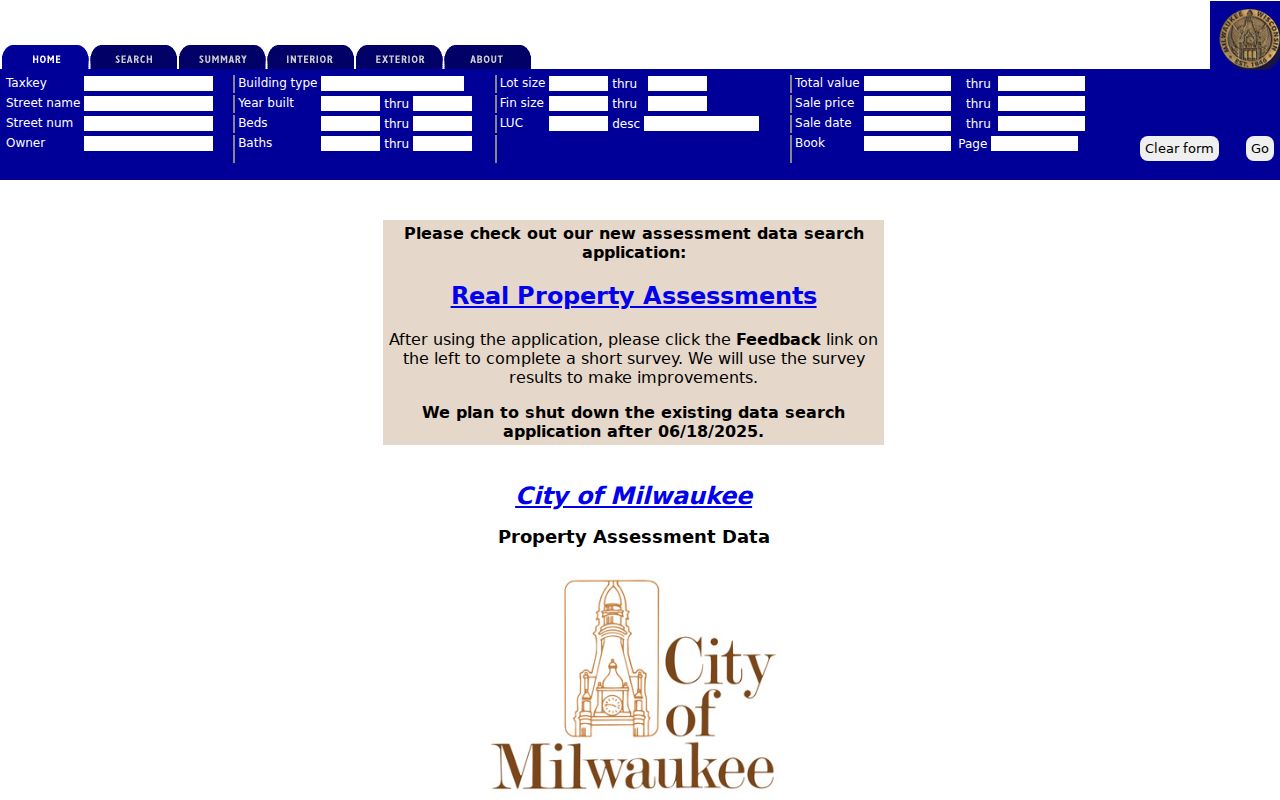
The screen is only the entry point. Note the parcel card date, and confirm any transfer in the recorded instrument itself.
Milwaukee Deeds Before 1948
Milwaukee County deeds are digitized back to 1835. Deeds recorded before April 1, 1948 must be found by document number or book and page. Later deeds search by grantor, grantee, tract, or document number, and everything from 1962 forward is digitized. That split explains why an early resident can vanish from a modern name search in the county records.
Start with a taxkey and legal description. The Register of Deeds Digital Reel reproduces a City Tax Assessor grantor/grantee index by taxkey covering the 1920s through 1989. It can bridge the old search break. Tapestry charges for sessions and prints. Certified copies come from the county.
Current Milwaukee Resident Rolls
Current rolls differ in scope and legal meaning. Property systems name assessed owners and parcels. Recorded instruments name parties with land interests. MyVote returns details for one matching elector, court indexes list parties to public cases, and each source is a partial Milwaukee residents directory rather than a census.
| Source | Who It Lists | Keeper | Access |
|---|---|---|---|
| City parcel card | Assessed owners | City Assessor | Free City portal |
| MyVote | Matching elector's own record | Wisconsin Elections Commission | Required identity fields |
| Tapestry deed index | Recorded parties | Register of Deeds | Paid search |
| WCCA | Public case parties | Wisconsin Court System | Free case data |
| Neighborhood contacts | Organizations, not private rosters | City DCD | Public pages |
Keep the source date and role beside every result. A recorded owner is not always an occupant, and a case party is not always a current Milwaukee resident.
MyVote Milwaukee Self-Matches
MyVote Wisconsin asks for first name, last name, and birth date in name mode. Address mode wants street address, unit, city, and ZIP. A match shows registration, elections voted, officials, and absentee status. A deceased record returns no match. It is not an open browse of every person on a block.
Public voter files follow Wis. Stat. §6.36(6) and Wis. Admin. Code EL 3.50. Protected data and confidential electors are withheld. A clerk can provide lawful poll-list access, while the statewide file requires a written request and set fees, a route apart from the self-service lookup.
Milwaukee Court Name Records
Wisconsin Circuit Court Access can confirm a named person in a public Milwaukee County circuit case. A result may list county, case number, caption, party role, filing date, status, court activity, and disposition. That index is not a document library. Open copies come from the Clerk of Circuit Court.
Names alone are weak matches. Compare middle initials, dates, party roles, and related case numbers before trusting a hit, since sealed, juvenile, protected, and some family records never appear like ordinary civil cases. Municipal citations belong to Milwaukee Municipal Court. Federal cases use PACER.
Note: A missing WCCA match may reflect jurisdiction, sealing, spelling, or date coverage rather than proof that no record exists.
Milwaukee Vital Record Doors
The Register of Deeds for Milwaukee County keeps a specific slice of Wisconsin vital records. Births date from October 1, 1907, deaths from September 1, 2013, marriages statewide, and divorces from January 1, 2016. Wisconsin DHS holds the broader statewide set reaching back to October 1907. A divorce certificate is one page; the decree itself sits with the Clerk of Court.
Eligibility matters for certified copies. Deaths require a direct and tangible interest under Wis. Stat. §§69.20-69.21. No statewide vital index appears online, so orders go through official applications, mail, or a qualifying county service. Genealogy requests follow separate date ranges and appointments. These are evidence files, not a casual resident lookup.
Milwaukee Records by Municipality
Milwaukee County contains 19 municipalities. The City of Milwaukee alone publishes assessment rolls, Map Milwaukee, permits, inspections, and property systems. Each of the other 18 communities can name a different assessor, clerk, or permit custodian. Jurisdiction comes first. The County Land Information Office can confirm which municipality holds a given record.
A Milwaukee mailing address or ZIP code decides nothing. A blank City Assessor result is not a blank countywide result. The suburbs keep their own counters and Chapter 19 request routes. When no portal exists, phone the municipal counter or email the clerk directly.
Official Milwaukee Rolls Compared
Official rolls are narrow by design, yet their custodian, coverage dates, and purpose stay clear. Commercial summaries mix old city directory entries, marketing data, and filings, and they sometimes merge people with similar names. Treat that whole category as an unverified lead only, never as a records-office substitute.
| Source | Best use | Limit |
|---|---|---|
| Parcel or deed | Owner or recorded interest | Not proof of occupancy |
| Court index | Case party and dates | Documents may be offline |
| Library directory | Historical name and address | Coverage varies |
| Commercial compilation | Possible lead | Source may be unclear |
Milwaukee Directory Terms
Milwaukee record terms carry exact meanings, and one short word can flip a lookup result.
- Roll
- A list created for one task, such as assessment or elections.
- Index
- A finding aid that points to a full record.
- Parcel
- A mapped unit of land with a taxkey and legal description.
- Criss-cross directory
- A directory arranged by street address.
Owning a parcel and living on it are two different things in the records. The same goes for an index entry, which is a pointer rather than a certified copy.
Historic Milwaukee Resident Directories
Milwaukee Public Library holds one of the strongest city directory runs anywhere. Its volumes begin in 1847. They continue to the present, though with gaps. You can browse by name across the whole run; address browsing starts in 1921. Print volumes sit in the Zeidler Room. Microfiche covers 1847 through 1860. Microfilm covers 1861 through 1960. The library notes that this span is also on Ancestry Library Edition at participating locations.
One directory entry can tie a name to a street address. It can add a spouse, trade, business location, or householder mark. It never lists every person, though. For a solid Milwaukee residents directory trail, pair it with census records, deeds, probate files, newspapers, or permits.
Milwaukee's 1930 Address Shift
In 1930, Milwaukee remade nearly every street number in the city. That one change can sink an otherwise careful search. South-side street names changed too. Cambridge Avenue was renumbered more than once. The 1930 directory includes an address converter, and a Wauwatosa supplement records the 1931 changes, so keep both old and new forms on paper before you search.
A household sitting at one number in 1929 may still be in the same house under a different number in 1930. Intersections, the legal lot and block, the taxkey, and a Sanborn sheet all help test whether a family truly stayed put. A vanished old number never proves a move.
Milwaukee Obituary Index Runs
Milwaukee Public Library indexes death notices from three papers. Sentinel coverage runs 1844 through 1968. The Journal runs 1935 through 1980. The Journal Sentinel runs 1990 to the current collection. Access to images and text varies by entry. Try several name forms, then write down the paper, date, page, and source.
A notice can name relatives. It can give an address, or point to a congregation or the next place someone lived. Not every death got one. Read the original before adding the fact to a Milwaukee residents directory trail.
Milwaukee Archive Access in 2026
Milwaukee County's archival landscape splits cleanly by institution. The Milwaukee County Historical Society guards probate, naturalization, court, jail, coroner, family, business, and organization collections. These sit at its Anderson Research Library. That library moved to appointment-only access in May 2026. Hours now run Monday, Friday, and Saturday, in two-hour blocks, while collections shift off-site. Remote research is the practical fallback while the move plays out.
Other repositories fill different gaps. Milwaukee Public Library, the UWM Archives, the Wisconsin Historical Society, and the National Archives at Chicago each hold series the others lack. Every request should state the collection title, year, call number, box or folder, and access terms. A catalog flag of "library use only" points to the shelf. It does not put a scan in your hands.
Start with a catalog entry or collection description. Then send the repository one narrow question. Include the person's name variants and a date range. Add the Milwaukee municipality, any known address, and the exact record series you want. Directory and newspaper requests should add year and page when known. For manuscripts, cite the collection number and box or folder scope. Keep the reply with its citation, because access status can shift while material is moved or digitized. A catalog miss proves little; names hide in unindexed folders, microfilm, and volumes read page by page.
Each repository carries its own weight. Milwaukee Public Library holds the city-directory spine, local newspapers, maps, atlases, immigration indexes, and published family histories. The City Archives at Central Library preserves records City employees created, though most sit offline. Inside the Zeidler Municipal Building, the Municipal Research Library adds tax, map, directory, and city-government material. The Historical Society reaches county probate, naturalization, coroner, organization, and family papers. UWM and the Wisconsin Historical Society extend the trail when a city or county catalog stops short.
Treat remote access like a planned visit. Identify the institution, collection, date range, and format first. Ask whether staff can check an index. Ask whether a research fee applies. Also ask whether copies arrive by email or mail. If an item is library-use only, get the exact desk and current appointment rules. For a resident trail, preserve the source's original spelling and old street form in the citation. That habit explains why a later portal, modern address, or standardized family name sometimes returns no match at all.
Build the citation while the record is still open. Record the repository, collection or volume title, year, page, image number, and date accessed. When staff supply a copy, file the request with the response. Those details let another researcher retrace the Milwaukee resident record. They also help tell a true gap from a catalog, spelling, or access problem.